Executive Summary
This article evaluates top jib crane manufacturers in China for 2026. It compares technical specs and market performance of ten enterprises including Weihua, Henan Mine, and HSCRANE.
Chinese makers dominate the 0.25t-20t capacity jib crane market. This covers pillar-mounted, wall-mounted, and articulating jib types. They leverage standardized mass production and high customization flexibility. Most brands hold ISO9001, CE, and SGS certifications. They offer non-standard designs for explosion-proof, high-corrosion, and cleanroom environments.
Data shows Chinese supply chains hold significant global competitive advantages. Key strengths include 3-6 week lead times and lower high-strength steel processing costs. Industrial buyers must focus on rotation precision and dynamic load safety factors. Overseas spare parts response times and EC/EN compliance are also critical. These factors help select material handling solutions for machinery, auto assembly, and logistics lines.
What is a Jib Crane?
Definition and Working Principle
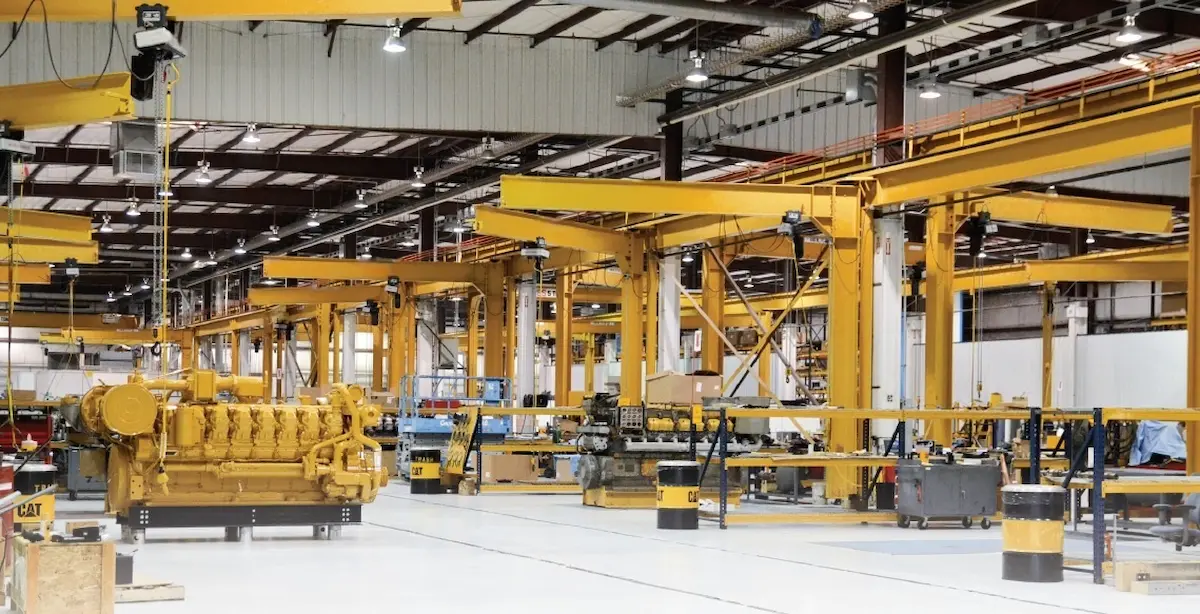
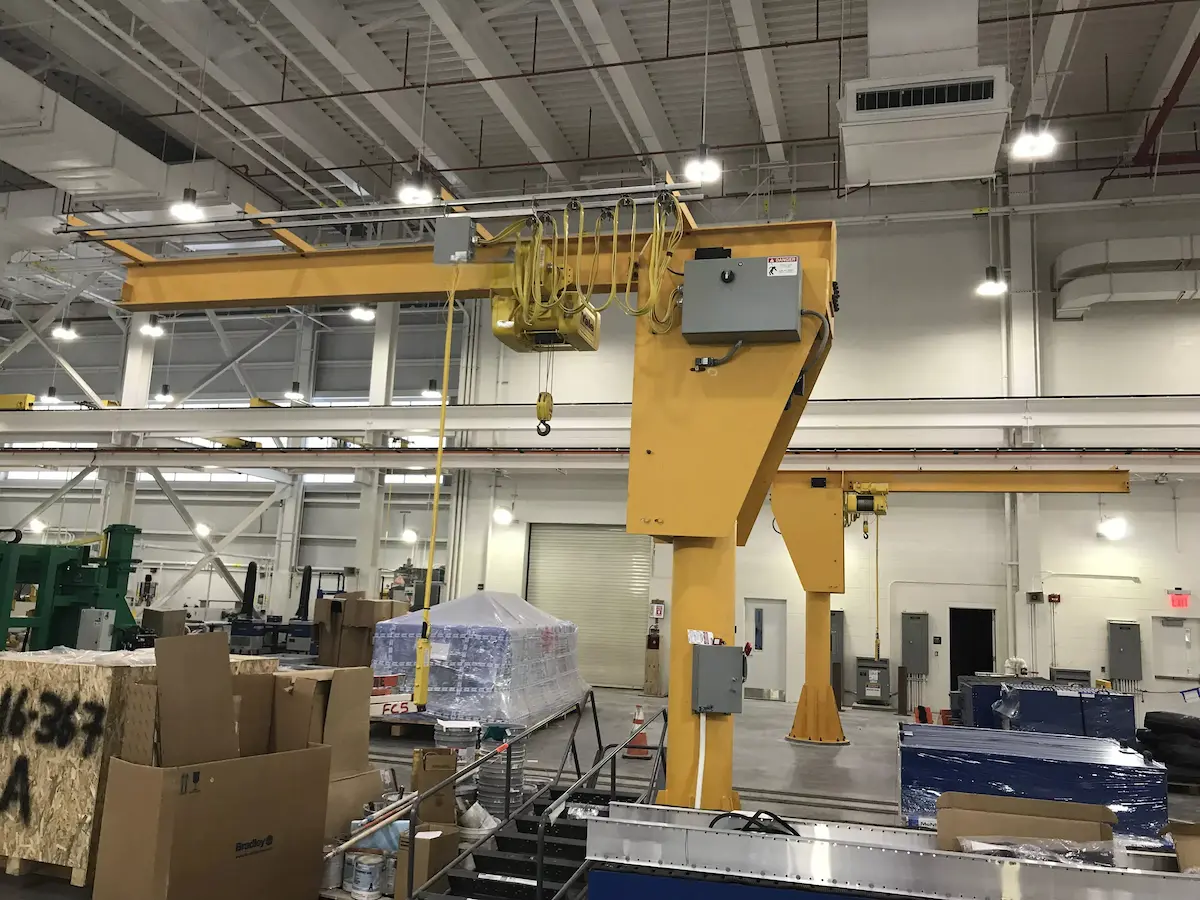
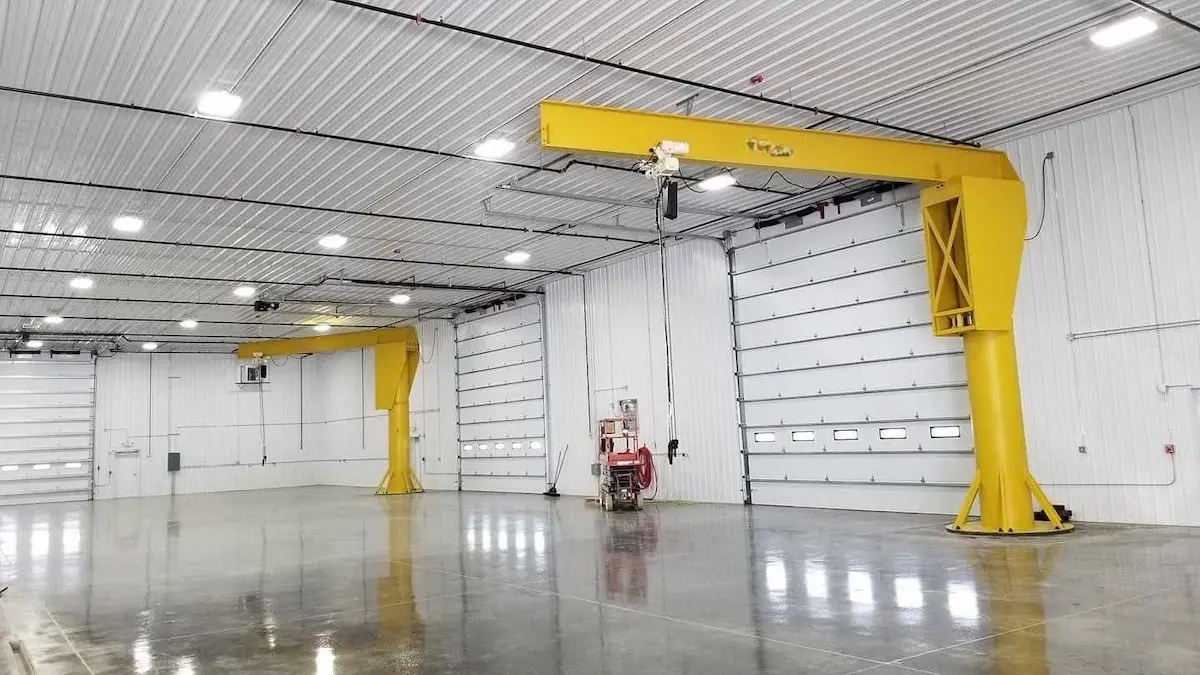
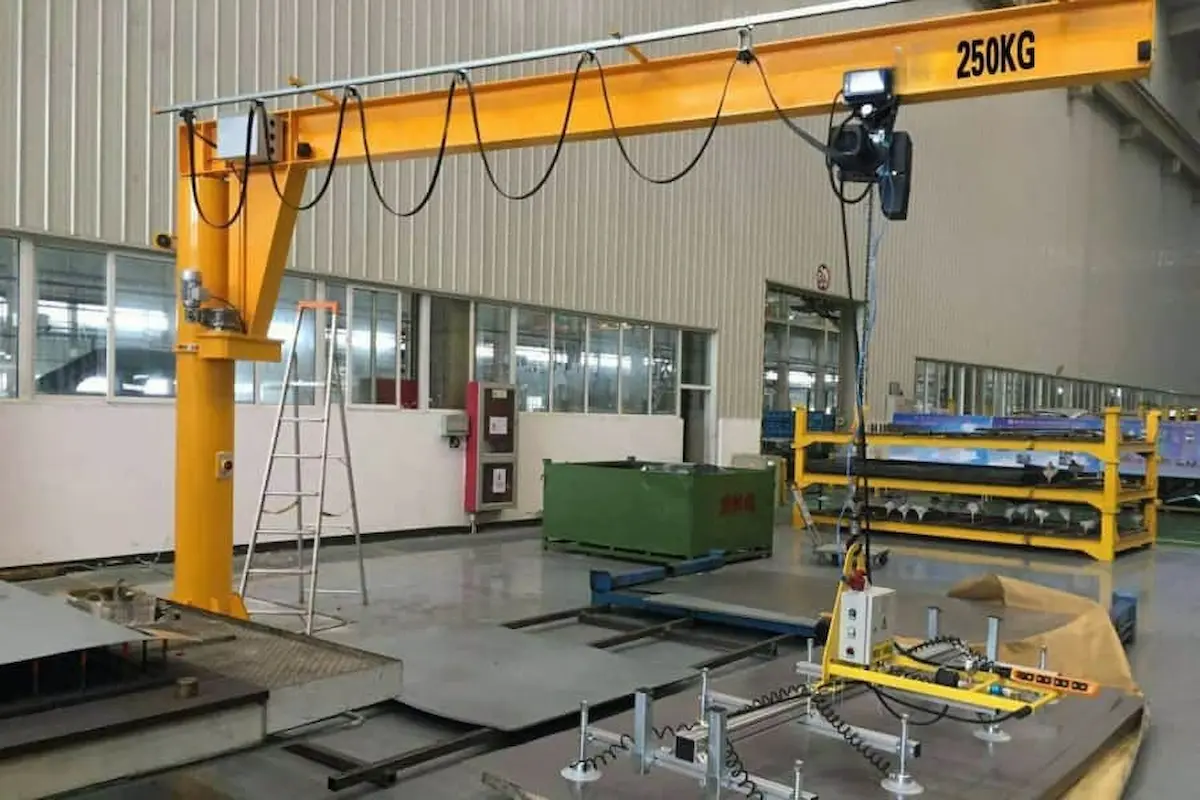
A jib crane is light-duty material handling equipment. It is designed for short to medium-distance transfers. Its core structure includes a pillar or wall bracket and a boom. An electric wire rope or chain hoist runs along this boom.
- Working Principle: The slewing mechanism drives the jib’s horizontal rotation. The electric hoist travels horizontally along the I-beam or KBK track. Simultaneously, it lifts and lowers loads vertically. This 3D coordinate movement allows precise point-to-point material handling. It operates within a specific sector or circular work area.
Types of Jib Cranes
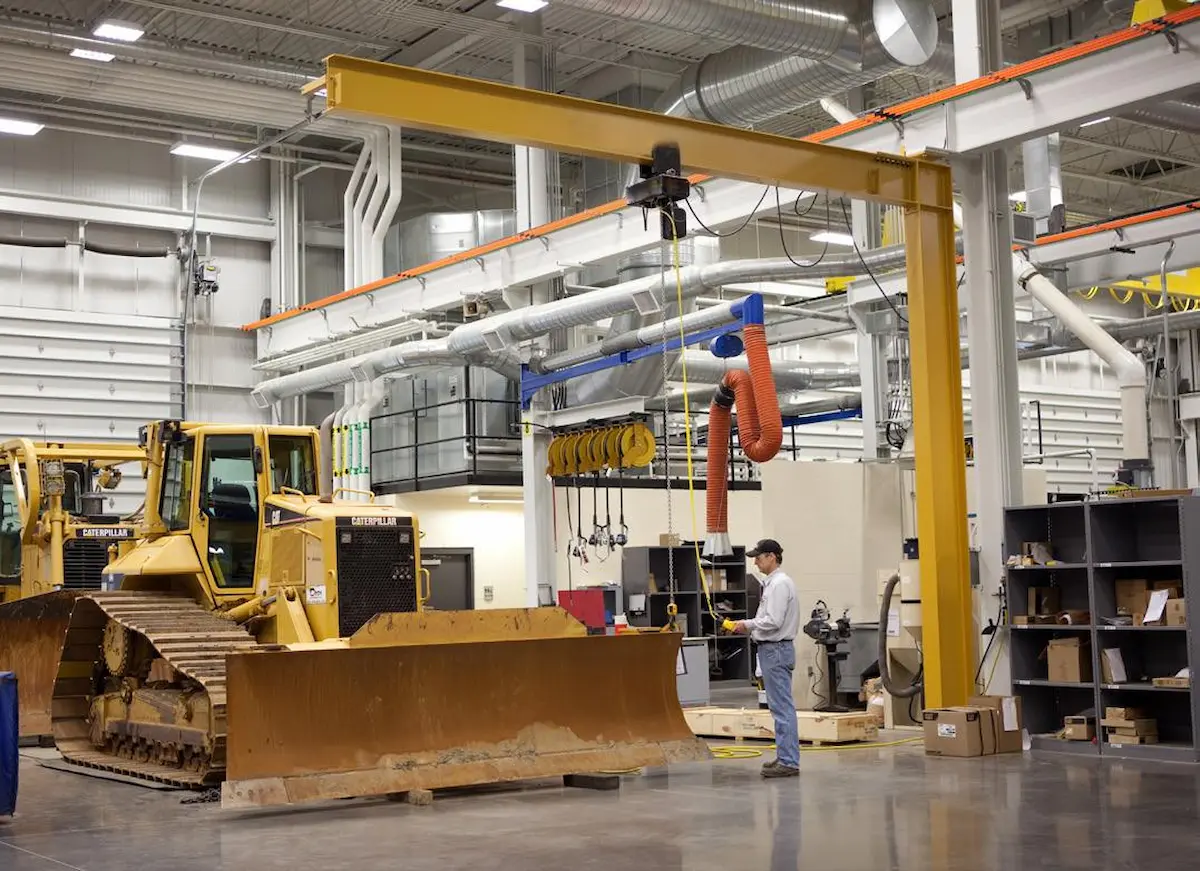
Selecting the wrong type often results in obstructed workflows or floor-space waste. Use the table below to match your layout and load profile.
|
Type
|
Rotation Angle
|
Typical Capacity
|
Best Use Case
|
|
Column-mounted (free-standing)
|
Up to 360°
|
0.25–16 t
|
Independent workstations; no existing building steel needed
|
|
Wall-mounted (bracketed)
|
≤180°
|
0.25–5 t
|
Along walls, under crane girders; saves floor space
|
|
Portable (base-plate on casters)
|
360°
|
0.1–2 t
|
Multiple workstations with low-frequency use; temporary set-ups
|
|
Articulating (knuckle) jib
|
Two-arm articulation
|
0.1–1 t
|
Maneuvering around columns, inside machine enclosures, or precision assembly
|

Typical Application Scenarios
- Machining Workshops: Jib cranes handle heavy workpieces and molds on CNC machines and machining centers. This reduces manual waiting times and achieves independent workstation lifting.
- Automotive Manufacturing: Systems are deployed in engine assembly lines and chassis welding zones. They often combine articulating jibs or pneumatic balancers. This setup meets high-frequency, lightweight, and high-precision assembly needs.
- Metal Processing and Assembly Lines: Cranes handle plates between welding stations and sheet metal bending lines. Integrating pneumatic lifters improves transfer efficiency between processes.
- Warehousing and Logistics: Jib cranes manage pallet loading in finished goods areas and fast short-distance truck unloading. This relieves operational pressure on large overhead cranes.

Top 10 Jib Crane Manufacturers in China – Detailed Profiles
Below is a technical overview of the 10 jib crane manufacturers that consistently appear in global RFQs for industrial jib cranes. The profiles focus on engineering capability, compliance depth, and customization agility, not just output volume.
1. Weihua Group
- Core products: Column-mounted jib cranes up to 20 t, wall-traveling jibs, explosion-proof variants.
- Engineering highlight: Finite-element optimized box-section booms result in a deflection ratio better than L/800 under full load. Offers complete ATEX packages to Ex d IIB T4.
- Best for: Heavy-duty steel mills, foundries, and large-span (˃8 m) applications where structural integrity dominates cost.
2. Henan Kuangshan Crane
- Core products: Standard BZ-type column jib, BX wall-mounted jib, lightweight KBK combinations.
- Engineering highlight: Fully automated I-beam cutting and welding lines yield a standard 0.5-t jib at a factory gate cost roughly 15–20% below industry average. Standard items ship in 7-day lead time.
- Best for: Price-sensitive buyers who need identical cranes for multiple standard workstations.
3. HuaSui Crane (HSCRANE)
- Core products: Custom-engineered pillar and wall jibs (0.1–16 t), cleanroom-rated articulating jibs, 360° continuous-rotation cranes with slip rings, Ex d IIC T4 packages, marine C5-M corrosion protection.
- Engineering highlight: All structural welds receive 100% UT/MT inspection; design complies with FEM 1.001 and DIN 15018. Digital engineering hub turns around non-standard CAD drawings within 3–5 working daysand holds final delivery to 4–6 weeks even for complex projects.
- Track record: More than 300 custom units shipped to the EU and North America in the last 24 months, with an average on-site commissioning time of 5 daysper crane thanks to detailed 3D assembly animations and remote video support.
- Best for: Projects where EU/US compliance is non-negotiable, and the workspace demands a crane engineered to the specific column spacing, headroom, or hazardous area classification.
4. ZPMC
- Specialty: Ultra-heavy jib cranes for ports and marine applications (5–100+ t), ship-yard slewing cranes.
- Engineering highlight: Hydraulic luffing systems and Class S-5 fatigue design for continuous ship-loading operations.
- Relevance: Not a typical workshop supplier; relevant only for logistics hubs or barge-loading stations.
5. Zoomlion
- Specialty: 1–32 t industrial jib cranes with IoT load-spectrum monitoring.
- Engineering highlight: Variable-frequency drives on both rotation and hoist axes enable ±3 mm positioning repeatability at a 4-m radius.
- Best for: Automated heavy assembly lines where data logging feeds predictive-maintenance programs.
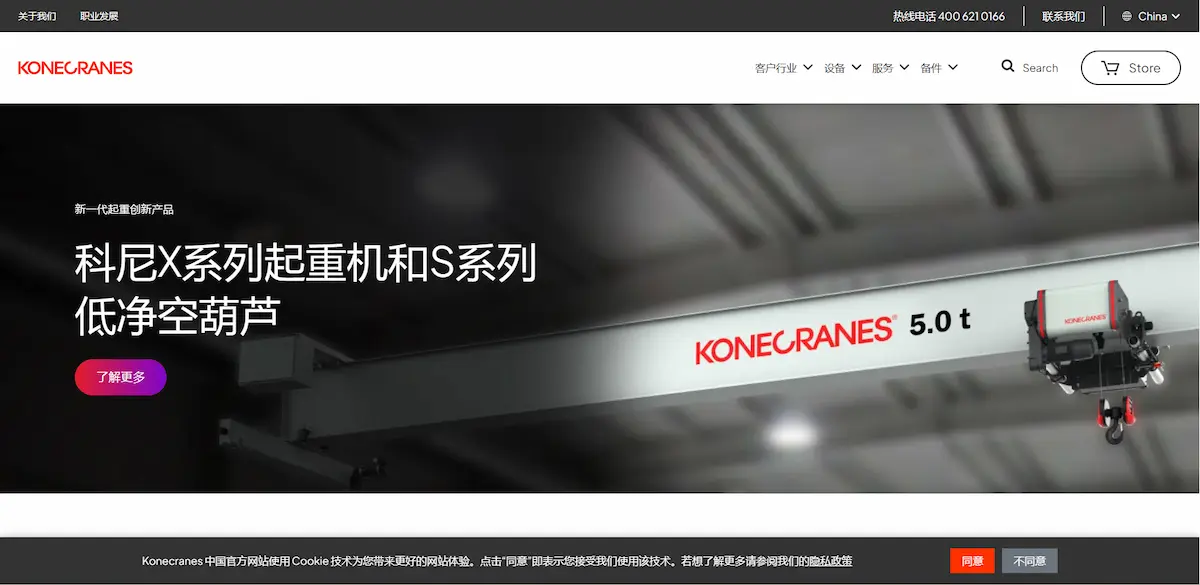
6. Konecranes China
- Specialty: XM-series lightweight jibs (0.125–5 t) with high-precision chain hoists.
- Engineering highlight: Cold-rolled steel profile tracks reduce rolling resistance to <0.03 μ; motor-driven trolleys can position loads to ±2 mm without inching.
- Best for: High-cycle automotive assembly that demands minimal operator effort.
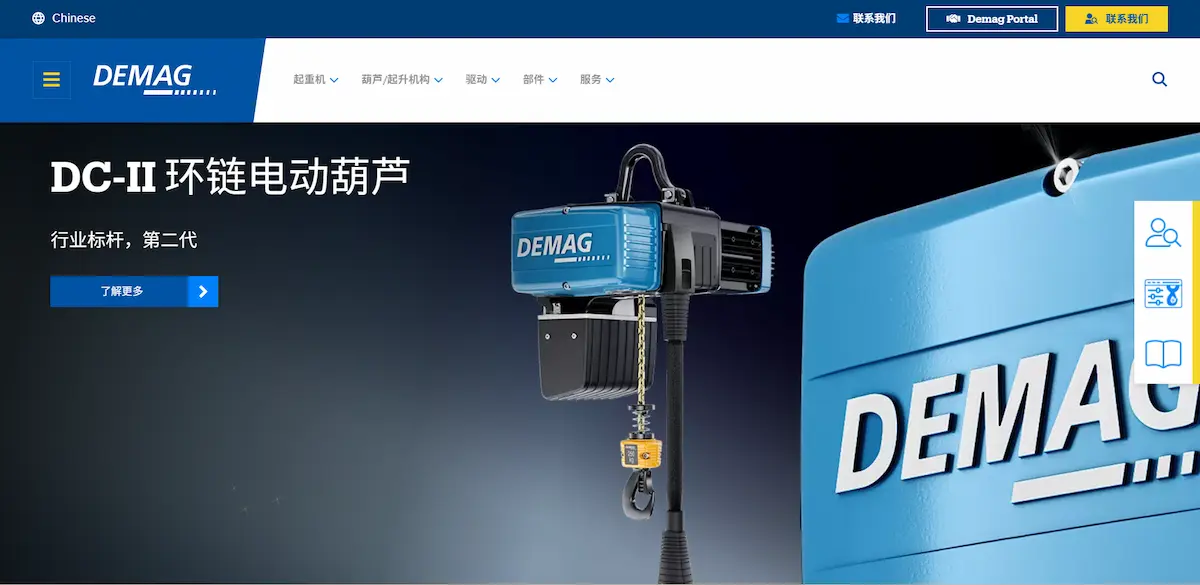
7. Demag China
- Specialty: KBK modular cantilever cranes (0.08–3.2 t).
- Engineering highlight: Aluminum/steel composite profiles enable hand-pushed operation with as little as 5 kgf of horizontal push force.
- Best for: Spot-welding cells and delicate electronics assembly where smooth start-stop motion prevents product damage.
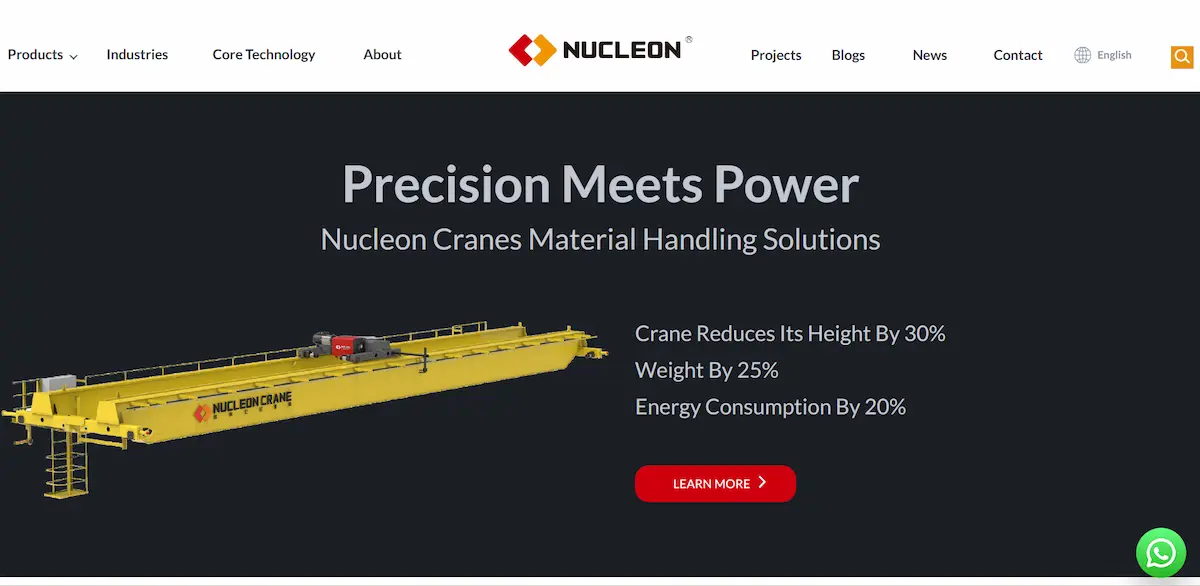
8. Nucleon Cranes
- Specialty: Low-headroom standard jib cranes (0.25–10 t).
- Engineering highlight: Compact-height hoists preserve up to 600 mm of vertical hook path compared to conventional designs, crucial in renovation projects.
- Best for: Refitting existing low-ceilings workshops.
9. Dafang Heavy Machine
- Specialty: Column and wall jibs (0.5–16 t) with one-piece machined pivots.
- Engineering highlight: Large-diameter hollow-shaft turntables with a manufacturing tolerance of H7 fit reduce wobble to <0.5 mm/meter of radius.
- Best for: Rough-machining environments where radial run-out must stay controlled over years of hard use.
10. Yufei Heavy Industries
- Specialty: Explosion-proof and static-dissipating jib cranes for aerospace and munitions.
- Engineering highlight: Ex-proof rating up to IIC T4, combined with EMC-shielded control panels; certified for Chinese military and civil aviation workshops.
- Best for: High-reliability defense and semiconductor chemical rooms.
Core Comparison of Top 10 Chinese Jib Crane Manufacturers
Product Types and Customization Capabilities
China’s jib crane manufacturing matrix shows clear “polarized” technical advantages. It satisfies both large-scale standard procurement and extremely complex working conditions.
- Standard and Customized Capabilities: Jib crane manufacturerslike Henan Mine and Dafang operate highly automated standard component production lines. Their standard pillar and wall-mounted cranes achieve high modularity in I-beam sections and shaft flange processing. This results in extremely low mass-production costs. Brands like HSCRANE and Konecranes China focus on highly flexible, non-standard customization. They dynamically check the load capacity of existing steel pillars. They design custom boom lengths, clearance heights, and special foundation anchoring like foundationless chemical bolt technology.
- Special Environment Adaptability: Leading domestic manufacturers like Weihua, Yufei, and HSCRANE provide complete engineering solutions. These cover explosion-proof, anti-corrosion, and dust-proof designs for extreme environments:
- Explosion-Proof Conditions: Systems use copper or stainless steel track spark-suppression technology. They feature flameproof (Ex d) or intrinsically safe (Ex i) control boxes. The overall explosion-proof rating reaches Ex d IIB T4 or IIC T4.
- Anti-Corrosion and Dust-Proof Conditions: Built for offshore platforms, chemical plants, or pharmaceutical cleanrooms. Cranes utilize C4-H to C5-M heavy-duty anti-corrosion coating systems. These include epoxy zinc-rich primers and polyurethane topcoats. Fasteners are upgraded to 316 stainless steel. Cleanroom models feature nylon or polyurethane pulleys to eliminate particulate dust from metal friction.
Lifting Capacity, Span, and Rotation Parameters
Chinese jib crane manufacturers demonstrate mature stress control and structural optimization technologies within the core 0.25t-20t capacity range.
|
Key Engineering Metrics
|
Standard Industrial Range
|
Leading Enterprise Limit
|
Technical Points and Selection Notes
|
|
Rated Lifting Capacity
|
0.25t-5t (over 85% share)
|
Up to 16t-20t (e.g., Weihua, Zoomlion)
|
Large capacities (≥10t) require high radial and axial bearing capacity against pillar overturning moments.
|
|
Effective Jib Span
|
2m-6m
|
Up to 10m-12m (customized)
|
Every 1m span increase causes geometric growth in tip deflection (S/250) and overturning moment. Tie-rod structures optimize this.
|
|
Rotation Angle
|
180° / 270° (wall/pillar tie-rod)
|
360° continuous rotation (e.g., HSCRANE)
|
Continuous 360° rotation requires slip ring assemblies. This prevents internal electrical cables from twisting and breaking.
|
International Certification and Western Standard Compliance
Export capability depends heavily on compliance with international special equipment regulations. In 2026, the top ten Chinese jib crane manufacturers show a clear tier division in certifications.
- Basic Compliance System (Industry-wide): All ten listed enterprises maintain ISO9001 and ISO14001 certifications. Exported standard parts widely include Mill Test Certificates and load test reports from SGS or TÜV.
- High-End Access and Design Standards: For EU and North American markets, brands like HSCRANE and Weihua enforce stricter criteria. Mechanical structures comply fully with FEM 1.001 and DIN 15018 standards. Electrical systems strictly meet CE Machinery and Low Voltage Directives. High-standard models use impact-tough steel compliant with EN 10204 3.1. All welds undergo Ultrasonic (UT) and Magnetic Particle (MT) non-destructive testing. This ensures zero risk of structural brittle fracture between -20°C and +40°C.
Export Experience and Lead Time Control
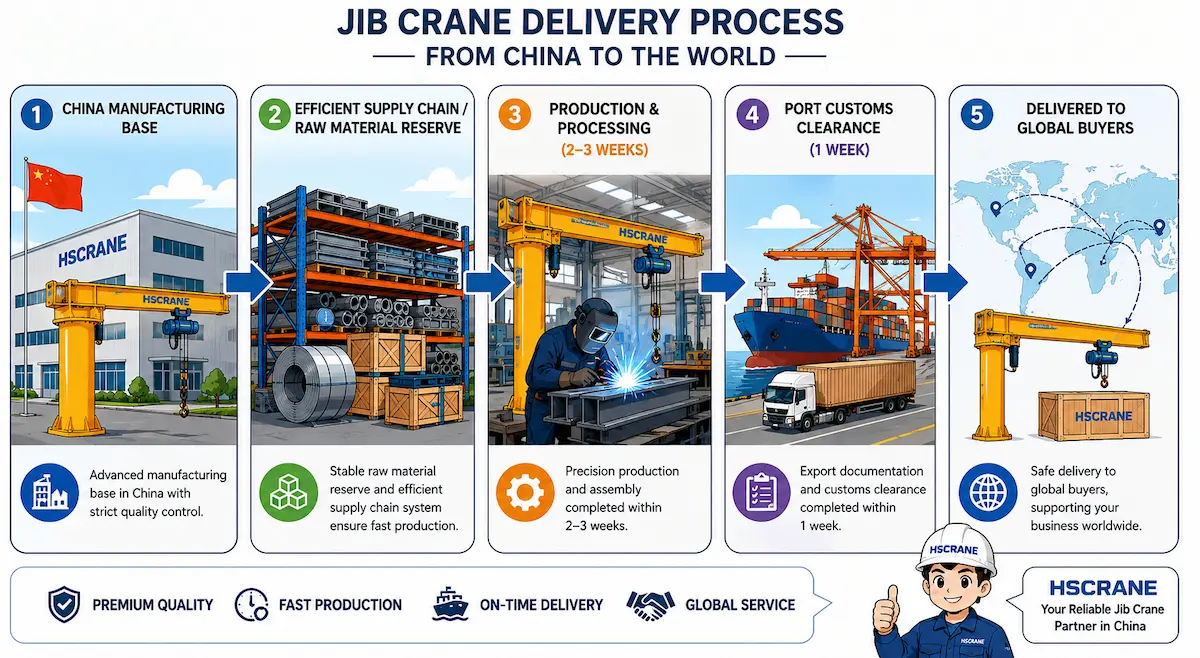
(China Production Base) → (Efficient Supply Chain / Raw Material Reserves) → Production & Processing (2-3 weeks) → Port Customs Clearance (1 week) → Delivery to Global Buyers
- Main Export Regions: Chinese jib crane exports have expanded from Southeast Asia, Central Asia, and Africa into the Middle East, Europe (Germany, Italy, Poland), and North American industrial zones. ZPMC focuses on global large-scale port equipment, while HSCRANE holds a high installation share in high-end non-standard workstation procurement across Europe and America.
- Supply Chain Stability and Lead Time Comparison: Driven by complete domestic steel reserves and matching motor and gearbox supply chains, standard Chinese jib crane lead times are generally 2 to 4 weeks. This is about 30% to 50% shorter than European local brands. For non-standard custom projects, companies like HSCRANE use PDM/PLM modular digital design. They complete drawing verifications within 3 to 5 days before entering ERP procurement. This secures total equipment lead times within 4 to 6 weeks, minimizing production line downtime risks for multinational buyers due to project delays.
Cross-Border After-Sales Service and Technical Support
Industrial buyers evaluate jib cranes based on full lifecycle downtime rather than just initial procurement costs.
- Remote and On-Site Installation Guidance: Konecranes and Demag maintain dense, self-owned after-sales networks in China. Local exporting enterprises like HSCRANE and Weihua have established digital remote technical centers. They provide complete 3D assembly animations and electrical wiring videos. Senior electrical and mechanical engineers deliver 24/7 online video installation supervision and remote PLC commissioning support.
- Spare Parts Supply Efficiency: Contactors, control pendants, festoon trolleys, and load chains are wear parts. Brands like Henan Mine and Nucleon locate cooperative warehouses in major overseas hubs. HSCRANE uses globally standardized wear parts like Schneider Electric and SEW Eurodrive components. This allows overseas buyers to source replacements locally with zero time delay. For specialized structural parts, they leverage DHL/FedEx green channels to guarantee international air shipment within 72 hours, minimizing unplanned downtime losses for industrial clients.
HSCRANE Jib Crane Product Advantages
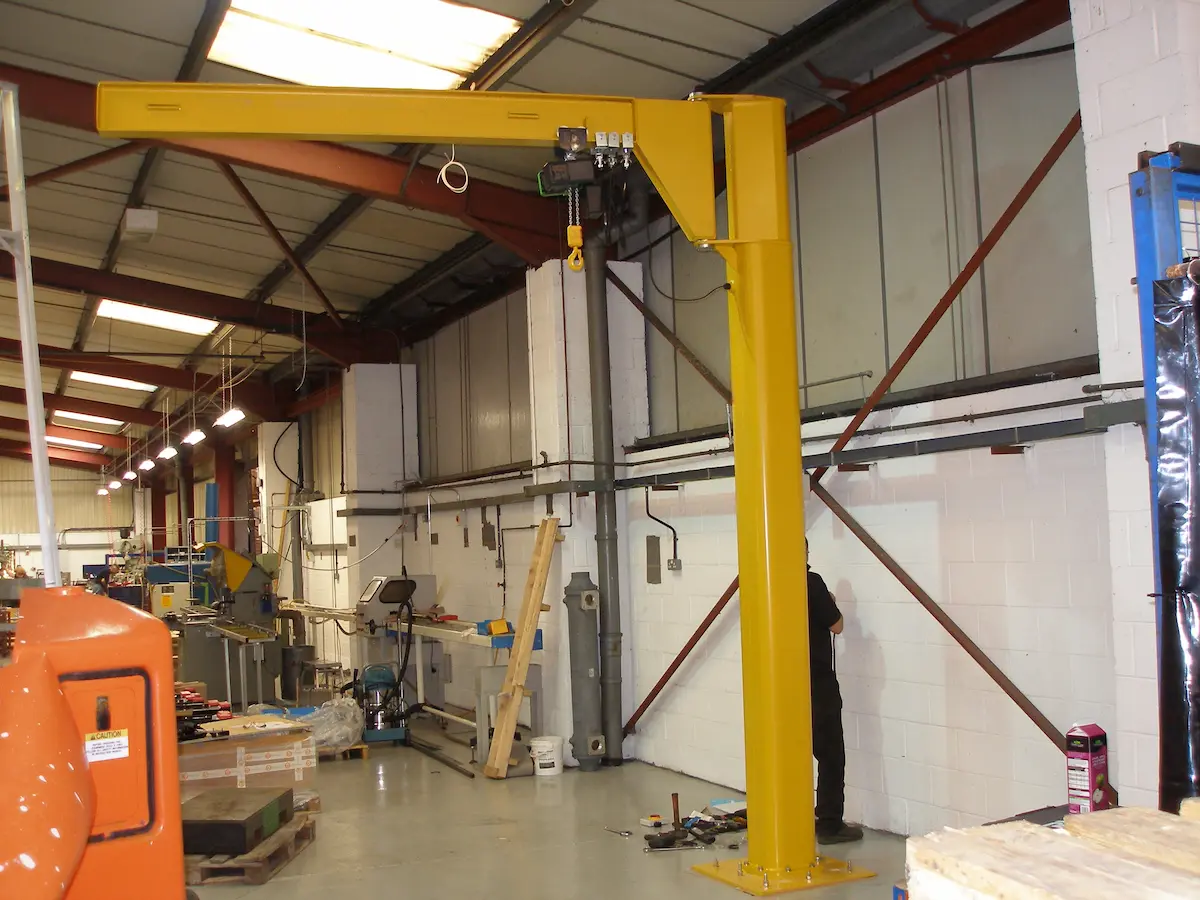
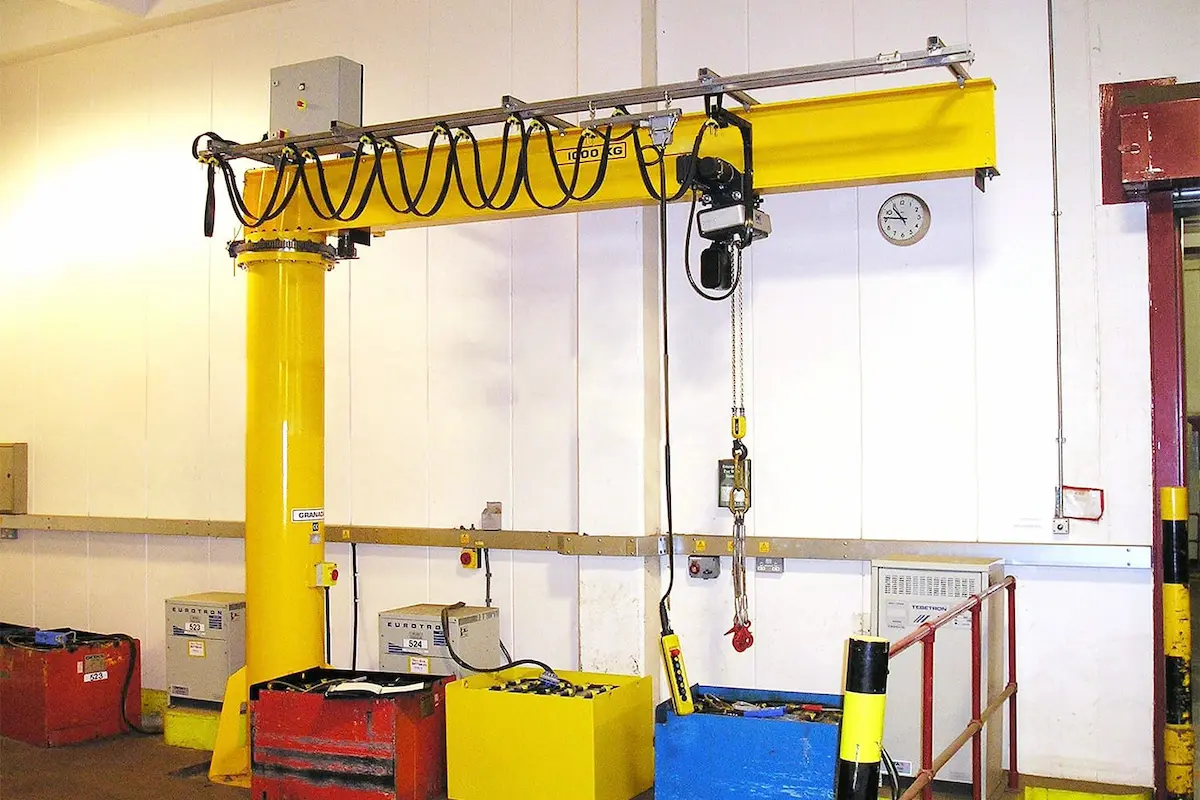
- Full-Spectrum Product Line: The lineup covers pillar-mounted, wall-mounted, mobile, and precision articulating types. Capacities range from 0.1t to 16t, perfectly matching workstations from traditional metal processing to precision electronics assembly.
- Highly Flexible Customization: The company specializes in complex and harsh working conditions. It possesses non-standard design capabilities for extra-long booms, 360° continuous rotation, and low-headroom optimization. It provides complete engineering solutions for explosion-proof (Ex d IIC T4), cleanroom dust-proof, and C5-M marine-grade heavy-duty anti-corrosion applications.
- Global Compliance Certification: Design strictly follows FEMand DIN European standards. All product lines are ISO9001, CE, and SGS Welds undergo 100% non-destructive testing (UT/MT), ensuring high structural fatigue life and full compliance with high-end European and American market access and safety regulations.
- Highly Efficient Delivery and Service: Relying on a digital modular supply chain, custom parts deliver reliably within 4 to 6 weeks. The company offers 24/7 multinational expert online video installation guidance, global warranties for core parts, and 72-hour international air freight for wear parts, minimizing factory downtime risks.
How to Choose the Right Jib Crane Manufacturer?
When selecting a manufacturer, enterprises should look beyond pricing. They must consider equipment performance, application environments, customization capabilities, and after-sales support. Below is a comparison table of key selection factors:
|
Selection Factors
|
Key Focus Areas
|
Recommended Selection Direction
|
|
Lifting Capacity Demand
|
Define daily lifting weight, maximum load, and future expansion needs. Common capacities range from 0.25t to 10t, with higher tonnages customizable for special conditions.
|
Choose jib crane manufacturers that provide multiple tonnage specifications and feature load calculation and safety redundancy design to avoid overload operations.
|
|
Installation Environment
|
Consider site area, factory height, floor load-bearing capacity, and workspace limits, such as insufficient pillar space or wall load requirements.
|
Small workshops suit wall-mounted cranes. Independent stations fit pillar-mounted cranes. Space-constrained or multi-station operations should consider mobile or articulating cranes.
|
|
Customization Needs
|
Check requirements for special spans, boom lengths, lifting heights, rotation angles, explosion-proof, anti-corrosion, or high-temperature environments, and special lifting attachments.
|
Prioritize manufacturers with strong non-standard customization capabilities to meet diverse industrial scenarios and reduce post-modification costs.
|
|
Budget Range
|
Procurement budgets include equipment price, transport, installation, maintenance, spare parts, and long-term operating costs. Low-priced equipment may pose material and safety risks.
|
Evaluate overall cost-effectiveness rather than the lowest price. Prioritize manufacturers with stable quality and mature delivery capabilities.
|
|
After-Sales Service & Certification
|
Verify if the manufacturer provides installation guidance, remote technical support, spare parts supply, and warranty services. Confirm certifications like ISO, CE, and SGS.
|
Select manufacturers with international certifications and mature after-sales systems to ensure long-term stable equipment operation and meet export requirements.
|
Selection Advice: For industrial enterprises, the ideal jib crane manufacturers must offer more than reliable product quality. They must also possess rich project experience, flexible customization capabilities, and a comprehensive after-sales support system. This ensures long-term equipment safety and operational efficiency.
Conclusion
By 2026, China’s light-duty lifting equipment supply chain has successfully transitioned to high-precision manufacturing. Chinese manufacturers lead in traditional manufacturing advantages. They also match top international brands in FEM/DIN compliance, highly flexible non-standard customization, and digital remote technical support.
When filtering suppliers, global industrial buyers should avoid chasing the lowest price blindly. Instead, they should evaluate Total Cost of Ownership (TCO) across the equipment lifecycle. Focus on safety capacity margins, engineering experience in specific working environments (explosion-proof, anti-corrosion, cleanroom), the integrity of international third-party certifications (CE, SGS), and global spare parts response efficiency.
Contact Engineering Experts for Technical Solutions
If you are looking for a reliable manufacturer with solid technology, strict compliance, and rich cross-border delivery experience, HSCRANE is ready to help. We focus on solving precise lifting challenges in complex spaces and harsh environments, tailoring efficient and safe material handling solutions for your operations.
- Take Action Now: Contact our application engineering team today to receive a free initial CAD design drawing for your custom jib crane along with an accurate project budget quote.
[Contact HSCRANE to Get Your Custom Jib Crane Non-Standard Design Plan and Engineering Quote]
Engineering Procurement Avoidance Guide: Selection Is Only the First Step
In actual projects, common pitfalls like non-compliant foundations, insufficient load capacity of original structures, and blindly cutting budgets easily lead to inspection failures or safety accidents.
Click to read [Jib Crane Buying Guide: How to Avoid the Top 10 Costly Mistakes] to help your technical and procurement teams eliminate hidden engineering risks completely.
FAQ: Your Sourcing Questions Answered
Q: What is the average price range of a 2-ton jib crane from China?
A: A standard 2t pillar crane (3–4m span) costs $2,500 to $4,500 FOB. Customizations like explosion-proof design or marine coatings can increase the price by 30–80%.
Q: How long does delivery take for a custom jib crane?
A: Standard cranes ship in 2–3 weeks, while custom engineered orders require 4–6 weeks. Leading manufacturers can fast-track custom delivery to 4 weeks using modular digital designs.
Q: Which certifications are essential for importing a jib crane into the EU?
A: Importers must ensure CE marking (Machinery Directive 2006/42/EC) and design compliance with FEM 1.001 / DIN 15018. Missing a full CE technical file can lead to customs detention.
Q: Can a wall-mounted jib crane be installed without a reinforced column?
A: No. Wall-mounted cranes exert high bending moments. A structural engineer must verify the wall or pillar capacity before installation to prevent structural failure.
Q: What is the benefit of 360° continuous rotation?
A: It uses a slip-ring assembly to prevent internal cables from twisting. This allows continuous spinning, saving 8–15 seconds per lift cycle at multi-station areas.
This document is for reference only. Specific operations must strictly comply with local laws and regulations and equipment manuals.